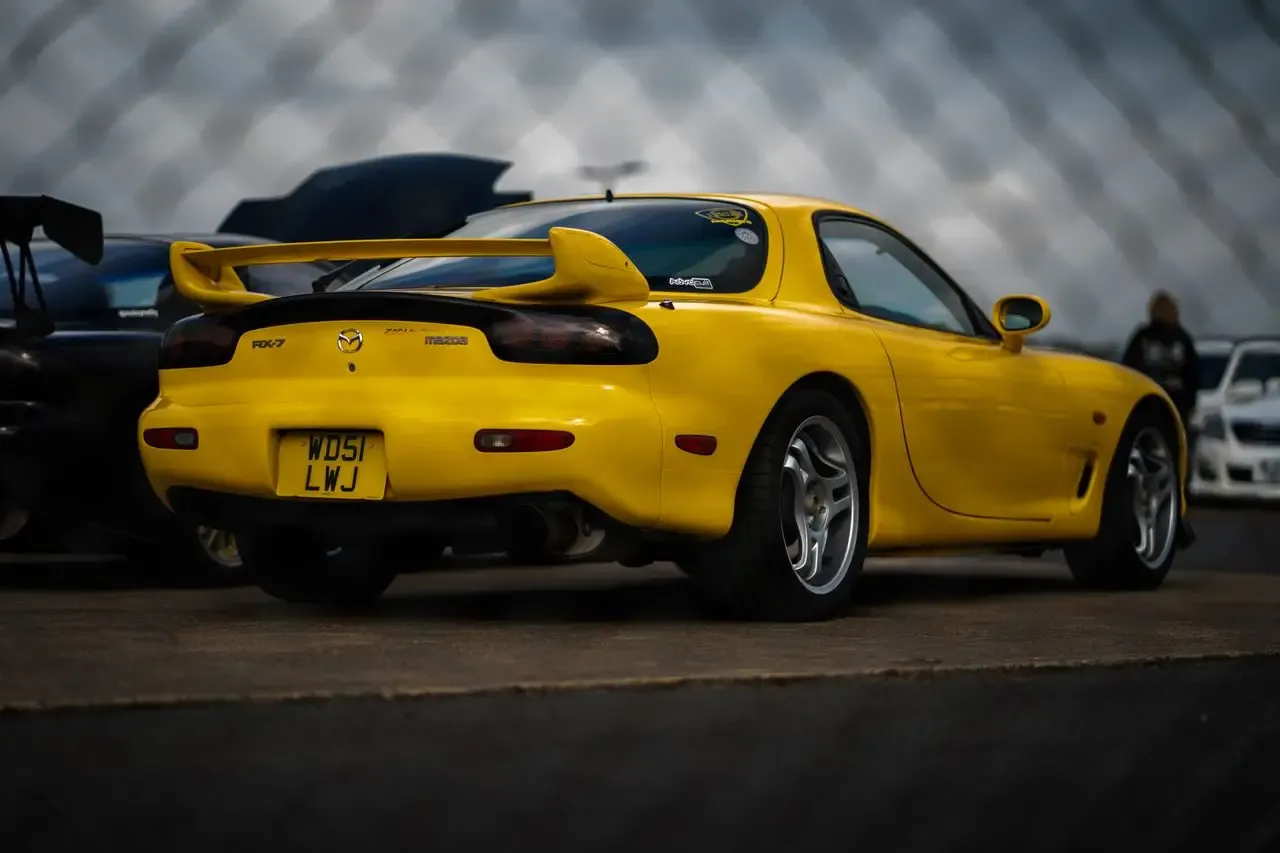
The FD RX-7 is the most beautiful car Japan has ever produced, and buying one badly will cost you more than the car is worth. Both of these things are true at once, and the gap between them is where most first-time owners get hurt.
Prices have settled into a shape that rewards patience. Tired Series 6 imports still surface under twenty thousand, clean Series 8 cars ask three times that, and the difference between them is almost never the difference in purchase price. Buy the best one you can find rather than the cheapest one you can afford — this is advice everyone gives about every car, but with a rotary it is closer to a law.
Compression before everything
Nothing else on the inspection list matters if the compression figures are wrong. Not the paint, not the interior, not the service history.
A healthy 13B-REW should show around 7.5 to 8.0 bar per face, with all three faces on each rotor within roughly 0.5 bar of each other. Consistency between faces matters more than the absolute number. A car showing 6.5 across the board is nearer the end of its life than the middle of it, regardless of what the odometer claims.
Insist on a proper rotary compression test with the correct tester. A conventional piston-engine gauge will give you a number, and that number will be meaningless. If a seller resists, that resistance is your answer.
The things that actually kill them
- Cooling. The FD runs a tight thermal margin from the factory and forty years of radiator sludge does not help. Any car that has ever been properly overheated should be assumed to have damaged seals until proven otherwise.
- The sequential turbo plumbing. A vacuum-actuated system with a dozen hoses, several of which live in the hottest part of the bay and perish quietly. Symptoms present as boost weirdness and get misdiagnosed as turbo failure with expensive regularity.
- Deleted apex seal oil injection. Some owners disable the factory oil metering pump and premix instead. Done knowingly, it is fine. Done accidentally, it is fatal.
- Rust. Rear arches, sills, and the area behind the front wheels. Japanese-market cars are generally better than the domestic ones, but “generally” is carrying weight.
The myths worth ignoring
That rotaries are disposable. They are not — they are maintenance-intolerant, which is different. An FD that gets its cooling sorted, its oil changed on a schedule you would consider excessive, and a warm-up it does not deserve will run for a very long time.
That every FD needs a rebuild at 60,000 miles. Some do. Plenty do not. The variable is not mileage, it is how the previous three owners treated the temperature gauge.
Budget for a rebuild you may never need, and you will enjoy the car. Budget for the purchase price alone, and the car will own you.
What to actually budget
Take the purchase price and add thirty per cent. That covers the cooling overhaul, the hose replacement, and the fluids that the seller’s “recent service” did not include. If the number still works, buy the car — there is nothing else on the road that does what an FD does, and the ones that survive are only getting rarer.