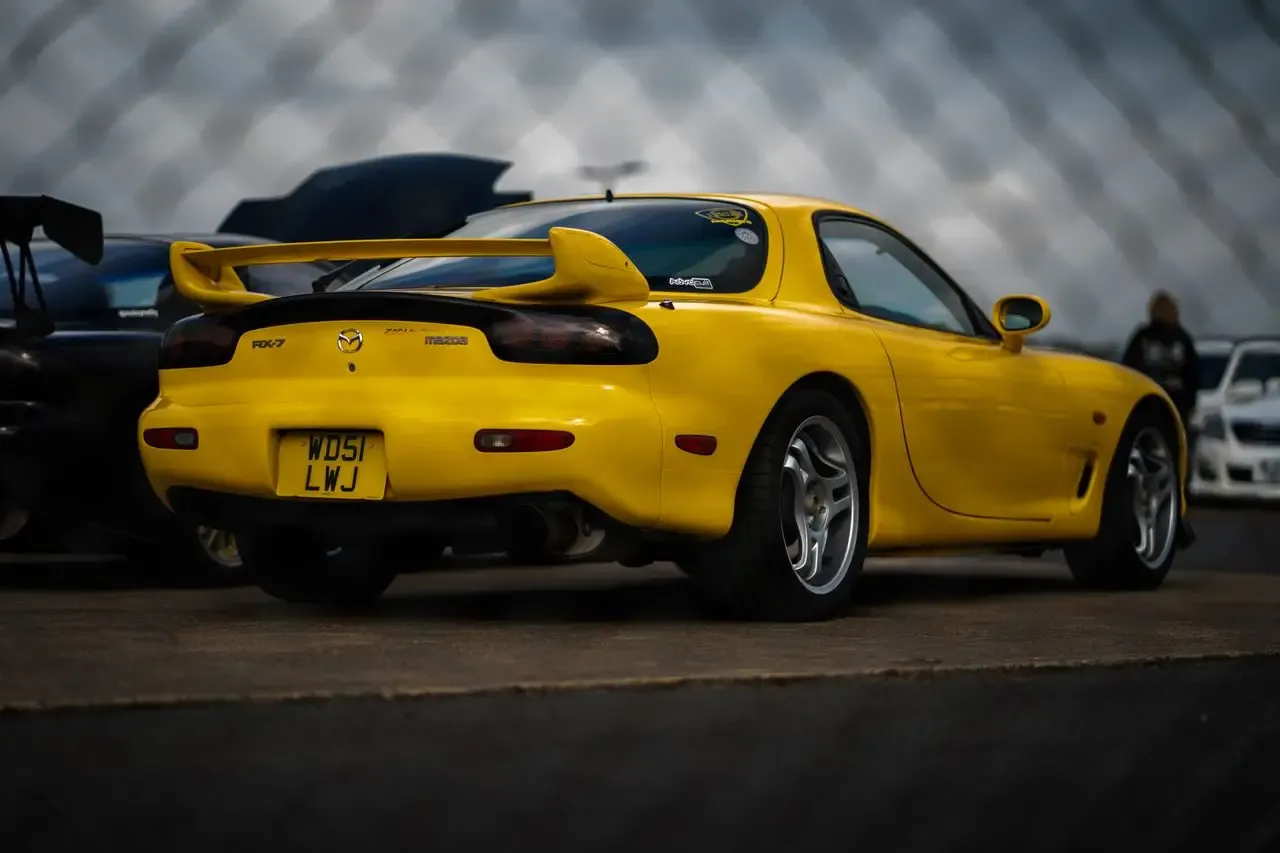
Priya Raman’s FD is the best-looking car at every meet it attends, and for two of the four years she owned it, it did not run. The second of those years was entirely her own fault, and she will tell you so before you have finished asking.
“Everyone warns you about the first rebuild,” she says. “Nobody warns you that you’ll do the second one badly because you think you know what you’re doing now.”
The first engine
The car arrived from a Yokohama auction in 2022 with a grade 4 sheet, 91,000 kilometres, and compression figures that were fine — genuinely fine, all six faces within tolerance. It ran for eleven months.
The failure was textbook and entirely preventable. A perished vacuum hose in the sequential system let boost creep past where the standard ceramic turbine wheels are willing to go. The turbo let go, the engine ingested what was left of it, and the rebuild was no longer optional.
“The hose cost about four pounds,” she says. “I had a list. It was on the list.”
The second engine
The first rebuild was done by a specialist and was, by every measure, correct. It lasted three years and would have lasted longer if she had left it alone.
She did not leave it alone. Emboldened, she took on the second rebuild herself — new seals, a mild port, a set of modern turbos to replace the ceramics that had killed the first engine. Everything went together carefully over one winter.
The mistake was the tune. A rotary running lean does not complain, does not knock, does not give you the audible warning a piston engine offers. It simply gets on with dying quietly and presents the bill three months later.
A rotary won’t tell you it’s unhappy. It will tell you it’s finished.
Why not a V8
The question comes up at every meet, usually from someone who thinks they are being helpful. There is a well-trodden LS conversion path for the FD. It costs less than what she has spent, makes more power, and would not have required either rebuild.
Her answer has not changed in four years: “Then it’s just a car.”
She is right, and the rest of us know she is right, which is why the question keeps getting asked in a slightly embarrassed way. The FD’s shape is the reason anyone wants one, but the reason anyone keeps one is the thing under the bonnet doing something no other engine does. Remove that and you have an extremely pretty chassis wrapped around somebody else’s idea.
Where it is now
Running. Third engine, professionally tuned, with a wideband and an oil temperature gauge in the driver’s eyeline where she can see them without looking for them.
She has driven it 4,000 kilometres since. Ask her what’s next and she says: “Nothing. That’s the plan. Nothing.”
Nobody at the meet believed her.